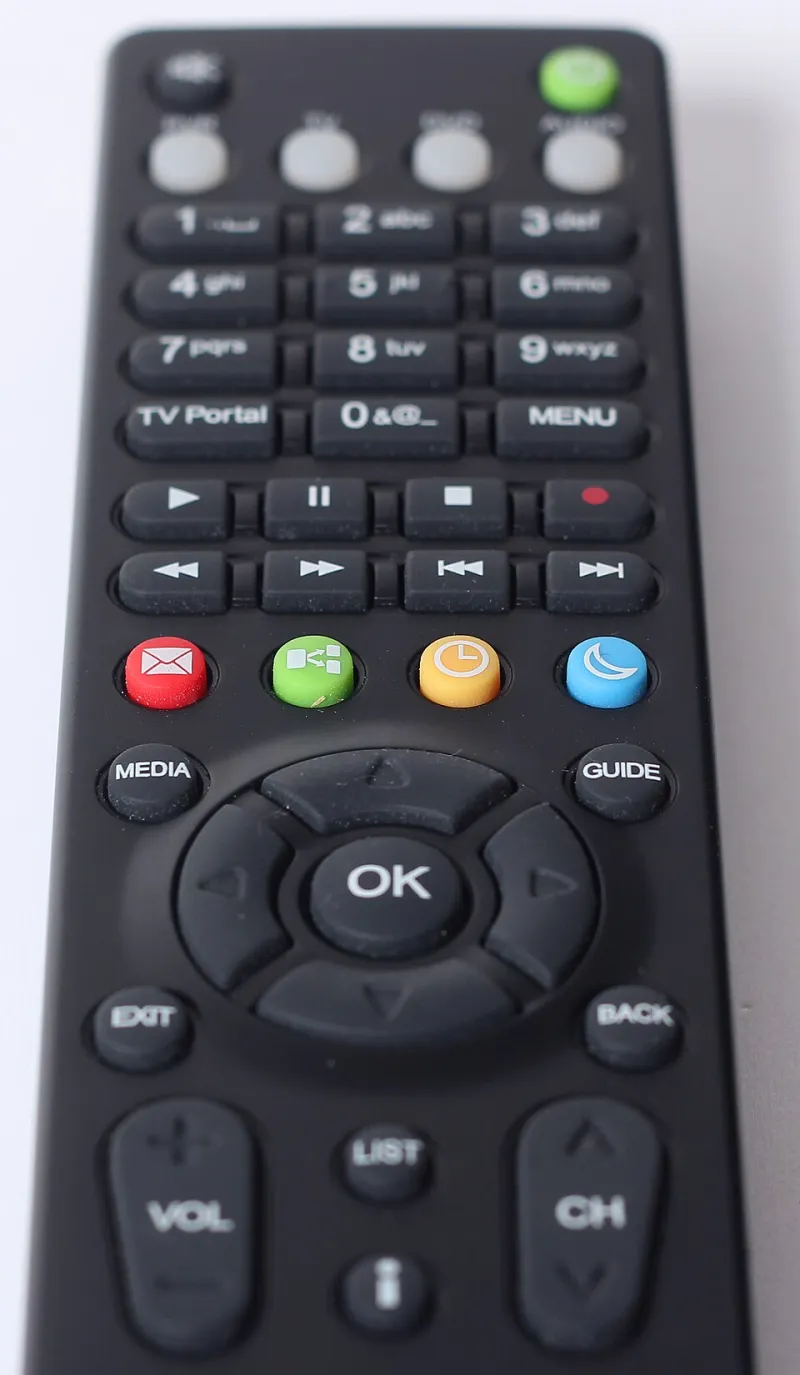
The Thumb Knows Before the Brain Does: Why 101 Will Always Mean BBC One

Photo: Unknown; possible authors: Eduardo Forte, Ricardo Alfieri, Gerado Horovitz or Marcelo Figueras, Public domain, via Wikimedia Commons
There is a moment, somewhere around 8.58pm on a Sunday, when your hand moves before your brain catches up. Three presses. Maybe four. You are not reading anything on screen. You are not scrolling. You are not being recommended to. You are just doing the thing you have done ten thousand times since roughly 2002, and you land on BBC One with the timing of a person who has never once been late for anything in their life.
Try to explain that to someone who only watches telly through an app. "I just know it's 101." They nod politely. They think you are being sentimental. You are not being sentimental. You are being accurate.
The Thumb Knows Before the Brain Does
Channel numbers are one of the last bits of shared, physical British knowledge. Nobody teaches them. Nobody puts them on a syllabus. They get absorbed, like knowing which side of the escalator to stand on or how long to wait before saying "anyway" at the end of a phone call.
And the muscle memory is genuinely odd when you stop to look at it, because it is not just the big five. It is the deep cuts. It is the second-nature knowledge that the +1 channels live in a tidy little cluster further up. It is knowing that the news is somewhere in the low 200s on one box and 503 on another and 107 on a third, and adjusting without complaint, like a driver changing gear on an unfamiliar hire car.
Ask a room of British adults to name the number for Channel 4 and watch how fast they answer. There is no pause. There is no visible thinking. The answer arrives fully formed, like a reflex.
A Deeply Unscientific Ranking of the Numbers We Actually Use
Right, let's be daft about it. Here is the Paam TV definitive (unofficial, arguable, please do not @ us) league table of iconic British channel numbers.
1. 101 — BBC One. The undisputed champion. It is not just a number, it is a national default. 101 is where you go when the telly has just been switched on and nothing has been decided yet. 101 is the screen-saver of British broadcasting.
2. 3 — ITV. Yes, I know it is 103 in the digital era. It does not matter. Generations of us grew up with ITV on 3, and the number still clings to the channel like a nickname. This is the entry that wins the nostalgia vote every single time.
3. 4 — Channel 4, obviously. The most pleasingly self-explanatory number in the whole business. A channel that named itself after its slot. Beautiful. More channels should have tried this, though we would have ended up with a strange amount of channels called 27.
4. The 600s and 700s — children's telly and the news. The CBBC zone, the news cluster, the place you were sent to as a kid and the place you were sent to as an adult. A whole life cycle in two number ranges.
5. The 900s. Uncharted territory. Do not go there. You know why. Everyone knows why. There is a whole mythology around the top end of the EPG that we should probably preserve as a piece of national folklore.
Honourable mentions go to the red button, which has lived at roughly the same address for years, and to every single "last channel" button on every remote ever made, which is quietly the greatest invention in the history of television and gets about four per cent of the credit it deserves.
The EPG Was an Accidental Map of the Country
Here is the thing the streaming people keep missing. The electronic programme guide was never designed to be loved. It was a functional bit of infrastructure, bolted onto the side of digital telly, mostly so you could find out what was on next without waiting for the announcer.
But because it was fixed, it became something else entirely. It became a shared reference. It became the reason you could say "stick it on 104" down the phone to your mum and she'd be watching within seconds. It became the reason two people in different houses, in different cities, with entirely different lives, could be looking at exactly the same screen at exactly the same time.
The order of channels was arbitrary. The order of channels was also, somehow, a map of what the country thought mattered. And because it never moved, we learned it.
There is a genuinely lovely side effect to all this, and it is worth saying out loud: a fixed channel list is one of the few bits of telly technology that is completely forgiving of the person using it. Your nan could work a number pad. A ten-year-old could work a number pad. Nobody needed a tutorial, nobody needed an account, and nobody needed to be profiled.
Why Streamers Keep Failing to Build Muscle Memory
Now compare that to the modern menu. Every time you open it, the tiles have shuffled. The top row is different. The "because you watched" shelf has decided you are a different person than you were on Tuesday. There is a trailer playing at you unprompted, and a countdown, and somewhere in there a show you actually wanted to watch, buried three scrolls down under something you'd never touch.
The apps have tried. They have added "channels" that are really just themed carousels. They have added numbers to them, occasionally, in the way a person who has never met a dog might describe a dog. But a number you have to look up is not a number. A number that changes is not a number at all.
Muscle memory needs three things: repetition, stability and consequence. Press the wrong channel number on Freeview and you get a slightly rubbish shopping channel — mild consequence, instant feedback, lesson learned. Press the wrong tile on a streamer and you have just agreed to autoplay three episodes of something about people renovating barns in Devon. That is not a lesson. That is a hostage situation.
A Small, Reasonable Plea to the People Who Design the Menus
We are not asking for a return to the dark ages. Nobody wants to go back to waiting for Ceefax to scroll round. But there are a few things that would cost almost nothing and would make an enormous difference.
Give us a number pad. Let us type. Let us learn a shortcut and keep it for a decade.
Give us a proper last-channel button that works across everything, apps included. It is the single most-used button in Britain and it is criminally under-served.
Give us a stable home screen. If a row must be reordered, do it rarely, and tell us. Stop rearranging the furniture while we are still sitting on it.
And give us back the feeling that the telly is a place with rooms in it, rather than a bottomless pit with a very good marketing department.
The Ghost in the Machine, Still Wearing 101
The telly is changing, and mostly for the better. There is more good stuff on more screens than there has ever been, and nobody in this house is pretending otherwise. But something small and ordinary is being quietly lost in the transition, and it is the kind of thing you don't notice until you are standing in someone else's living room, holding their remote, realising with genuine bewilderment that you have no idea where anything is.
The channel number is not nostalgia. It is a form of fluency. It is the difference between a country that knows its telly and a country that merely subscribes to it.
So here's to 101. Still there. Still first. Still the place your thumb goes when it hasn't decided anything yet. Long may it stay exactly where it is.